Received an Inheritance? 5 Smart Financial Moves Before You Spend or Invest a Single Dollar
Receiving an inheritance is often bittersweet. While it may provide financial security and new opportunities, it usually comes after the loss of someone important. Amidst the emotions of grief, beneficiaries are sometimes faced with one of the biggest financial decisions of their lives.
Many people spend years planning how to leave behind an inheritance. Yet very few prepare their loved ones for what comes next—how to manage that wealth responsibly.
Whether you’ve inherited cash, property, investments, or insurance proceeds, it’s natural to wonder:
- Should I invest it?
- Should I pay off my mortgage?
- Should I upgrade my home?
- Should I leave it in the bank?
There isn’t a one-size-fits-all answer. Before making any major financial decisions, it’s worth taking a step back and following a structured approach.
1. Don’t Make Any Major Financial Decisions Immediately
Receiving a large sum of money can trigger strong emotions. Besides grieving the loss of a loved one, you may also feel gratitude, responsibility, uncertainty, or even pressure from family members.
These emotions can cloud judgement and lead to decisions that may not align with your long-term financial goals.
Common mistakes include:
- Investing everything immediately because you fear “missing out”
- Upgrading your lifestyle too quickly
- Buying investment properties without proper planning
- Lending substantial sums to relatives or friends
- Chasing unusually high investment returns
A good rule of thumb is to give yourself time.
Unless there is an urgent financial need, consider placing the inheritance in a secure savings account or short-term fixed deposit while you develop a comprehensive financial plan. Taking a few months to think carefully is unlikely to make a significant difference to your long-term wealth—but making a rushed decision certainly can.
2. Understand What You’ve Actually Inherited
Many people immediately think of cash when they hear the word “inheritance.” In reality, inherited wealth can take many forms, each with its own financial implications.
You may receive:
- Cash or bank deposits
- Insurance policy proceeds
- CPF monies through CPF nomination
- Shares, unit trusts, ETFs or bonds
- Residential or commercial property
- Business ownership or partnership interests
- Overseas assets
- Valuable personal belongings such as jewellery or artwork
Before making any plans, take time to understand:
- What assets have been transferred to you?
- Are there any outstanding loans attached?
- What are the ongoing maintenance costs?
- Are there tax obligations in overseas jurisdictions?
- Has probate or estate administration been fully completed?
Having a clear picture of your inherited assets will help you make more informed decisions.
3. Build (or Strengthen) Your Financial Foundation
An inheritance should first strengthen your financial security before it is used to grow your wealth.
Many people jump straight into investing without first addressing weaknesses in their financial foundation.
Ask yourself:
Do I have an adequate emergency fund?
Aim to keep at least six to twelve months of living expenses readily accessible.
Am I carrying expensive debt?
Paying off high-interest debts such as credit cards or personal loans often provides a guaranteed financial benefit that exceeds most investment returns.
Is my insurance protection sufficient?
Review your life, health, disability and critical illness coverage to ensure they still meet your current needs.
Have I planned my own estate?
Ironically, many people inherit wealth before preparing their own estate plans. This is a good opportunity to review your Will, CPF Nomination and Lasting Power of Attorney.
Strengthening these fundamentals creates a more stable platform for long-term wealth management.
4. Decide What Role the Inheritance Should Play
Money without purpose is simply money at risk.
Before deciding where the inheritance should go, first ask yourself:
What do I want this inheritance to achieve?
For different individuals, the answer may be very different.
Perhaps the inheritance is meant to:
- Strengthen your retirement savings
- Help purchase your first home
- Reduce your housing loan
- Fund your children’s education
- Support ageing parents
- Generate passive income
- Preserve family wealth for future generations
When your objectives are clear, your financial decisions become much easier.
5. Investing an Inheritance: Avoid These Common Mistakes
Receiving a substantial inheritance often creates the temptation to “make the money work harder.” While investing can certainly be part of the plan, several common pitfalls should be avoided.
Mistake 1: Investing Everything Immediately
Markets fluctuate constantly. Investing a large lump sum without a clear strategy may expose you to unnecessary timing risk. A rushed decision could also lead you to invest in something that isn’t suitable for your needs or that you don’t fully understand.
A phased investment approach may be more appropriate, depending on your goals, investment horizon and risk tolerance. Take the time to understand the different investment options available before making a decision.
Mistake 2: Leaving Everything in Cash Forever
At the opposite extreme, some beneficiaries become so afraid of making mistakes that they leave the entire inheritance in a savings account indefinitely.
While this may feel safe, inflation gradually erodes purchasing power over time.
Cash should serve a purpose—not become the permanent destination.
Mistake 3: Chasing High Returns
Unfortunately, inheritance recipients are sometimes targeted by investment scams or “exclusive opportunities” promising unusually high returns.
Remember:
If an investment sounds too good to be true, it probably is.
Avoid making decisions based solely on potential returns without understanding the associated risks.
Mistake 4: Buying Property Just Because You Can
Property can be an important part of your financial plan, but receiving a large inheritance does not automatically mean you should upgrade your home or buy another property.
If the property is for your own use
A housing upgrade may improve your lifestyle, but it also comes with a long-term financial commitment.
Ask yourself:
- Do you and/or your family genuinely need the upgrade?
Is the additional space or location necessary, or are you simply upgrading because you now have the financial means to do so? - How much should you pay upfront, and how much should you borrow?
Paying off the property may reduce your interest costs and provide greater peace of mind, but keeping some of your inheritance invested or liquid may give you greater flexibility. - If you take on a mortgage, is the monthly repayment still comfortable?
Don’t assess affordability based only on today’s income. Consider future interest rates, potential career changes, children’s expenses and your other financial commitments.
An inheritance can give you the option to upgrade your home. It does not necessarily mean you should maximise that option.
If the property is for investment
Investment property can generate rental income and potentially appreciate over time. However, the headline rental yield or expected capital gain does not tell the whole story.
Consider:
- Have you factored in the ongoing costs?
Property tax, maintenance, repairs, agent fees, vacancy periods and other expenses can reduce your actual return. - What is the realistic rental demand and occupancy rate?
Don’t base your calculations on the assumption that the property will always be fully occupied or that rents will continue rising. - How much of your overall wealth will be concentrated in property?
If you already own a home, adding another property may leave a large portion of your wealth tied to a single asset class and a single market. - Are there alternative investments that could provide similar objectives with greater liquidity or diversification?
Property is not the only way to generate income or grow wealth. Consider whether other assets could achieve the same objective with fewer limitations or lower concentration risk.
Ultimately, the question should not be “Can I afford to buy another property?” but “Does this property make sense within my overall financial plan?”
An inheritance gives you more choices. The goal is to use those choices wisely—not simply to spend because you can.
Mistake 5: Lending Money to Friends or Relatives
Large inheritances sometimes attract requests for financial help.
Don’t get me wrong, supporting our loved ones is certainly important. Do bear in mind that lending significant sums without clear expectations can strain relationships and create unintended family conflicts.
Take time before committing to any financial assistance.
A Simple 5-steps Wealth Allocation Framework
Rather than viewing an inheritance as money to be spent, think of it as a resource to be allocated with intention.
One practical approach is to work through the following priorities.
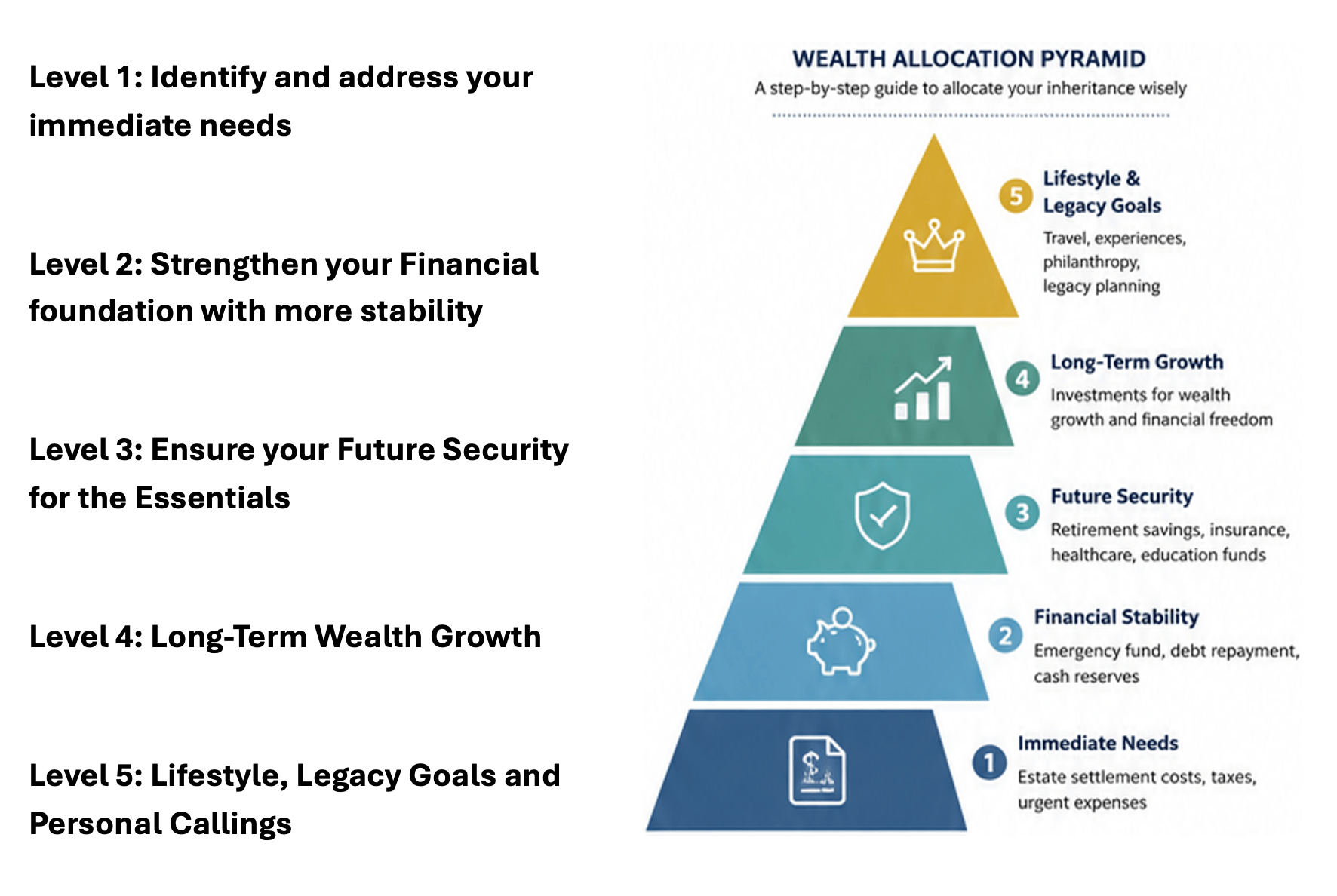
The goal is not simply to accumulate wealth, but to use it intentionally.
When Professional Advice Can Add Value
Not every inheritance requires professional advice. However, guidance can be particularly valuable if:
- You have inherited multiple properties
- Overseas assets are involved
- There are business interests to manage
- Your family situation is complex
- You are approaching retirement
- You are unsure how to deal with a significant lump sum
A financial adviser, together with your lawyer and accountant where appropriate, can help ensure your decisions are aligned with your long-term goals rather than short-term emotions.
Final Thoughts: Honour the Legacy, Build Your Future
An inheritance is more than a financial windfall.
For many families, it represents decades of hard work, sacrifice and careful planning by someone who hoped to provide a better future for the next generation.
The greatest way to honour that legacy is not necessarily by preserving every dollar untouched, nor by trying to maximise every possible return. Rather, it is by making thoughtful decisions that strengthen your own financial security, support the people you care about, and create opportunities for future generations.
Take the time to understand what you’ve inherited. Build a solid financial foundation. Invest with purpose. Spend intentionally.
After all, the true value of an inheritance is measured not only by the wealth you receive, but by the life it helps you build.
Article by Moo Hau Eng
Email: haueng.moo@gen.com.sg
The writer is a financial adviser representative representing GEN Financial Advisory Pte Ltd.