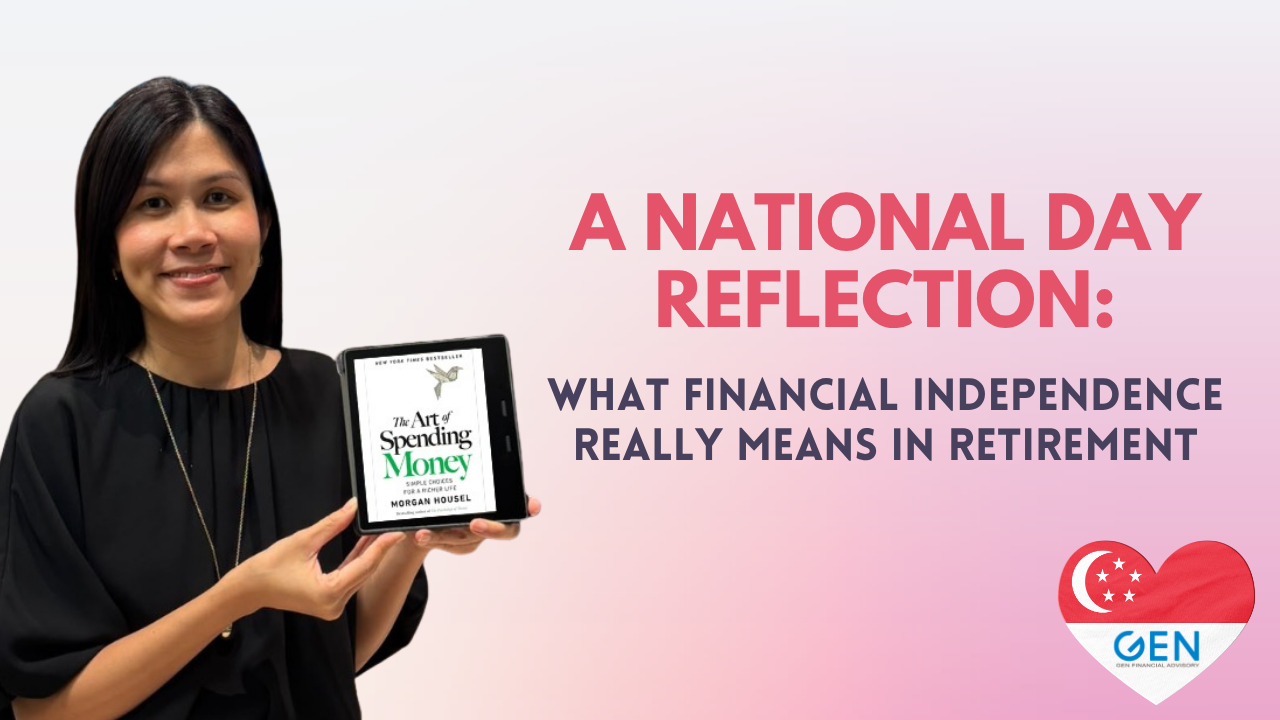
A National Day Reflection: What Financial Independence Really Means in Retirement

During the National Day holiday, I made time to read Morgan Housel’s latest book, The Art of Spending Money: Simple Choices for a Richer Life. Morgan Housel is well known for helping readers understand the psychology behind money. In this book, he turns his attention to a question that receives far less attention than saving and investing:
Once we have accumulated money, how do we use it to live a better life?
It sounds like a simple question. Yet it may be one of the hardest questions to answer particularly in retirement. For most of our working lives, we are taught to earn, save and invest. We watch our account balances grow and feel reassured when the numbers move upwards. Retirement eventually asks us to do something very different: draw an income from the same assets we spent decades building. This transition from saver to spender is not merely a financial adjustment. It is an emotional one.
The Retirement Spending Problem
One of Morgan Housel’s most important observations is that people do not always spend money in ways that make their lives better. Some spend to impress others. Others continue saving indefinitely because spending feels uncomfortable even when they have more than enough. This second problem is especially relevant to retirement and it is something I frequently encounter when working with clients on their retirement plans.
Why might someone with adequate retirement savings still hesitate to spend? The answer is not necessarily a lack of financial knowledge. Ironically, it may be the result of decades of good financial discipline. The habits that helped someone accumulate wealth, saving consistently, avoiding unnecessary expenses and protecting capital do not automatically disappear on the day they retire. When retirees see their bank or investment balances fall, spending can feel like depletion. Even when a withdrawal has been planned carefully and is sustainable, it may still create anxiety. Someone can therefore be financially prepared for retirement but not psychologically prepared to spend.
Saving for retirement and spending in retirement require two very different mindsets. We spend decades preparing people to accumulate wealth but far less time preparing them to use it.
Retirement Should Not Be About Worrying
When I speak to clients about retirement planning, the conversation often begins with this question: “How much money do I need for retirement?” It is certainly an important question. However, I believe there is an even more important one: “How will I turn my retirement savings into a sustainable income stream?”
Before retirement, our salary provides a natural structure. A paycheck arrives each month and we use it to pay for food, utilities, transport, healthcare, family needs and leisure. After retirement, the salary stops but the expenses continue. If a retirement plan consists only of a large pool of investments, every expense may feel like a decision to reduce that pool. Retirees may find themselves wondering:
- What if I live longer than expected?
- What if markets fall after I make a withdrawal?
- What if healthcare costs increase?
- What if inflation gradually reduces my purchasing power?
- What if I spend too much today and regret it later?
Retirement is not just about accumulating assets. Retirement is about generating income. This is why retirement should not be planned around a single lump sum alone. We also need to plan how that lump sum will support a regular and dependable cash flow throughout retirement.
When Spending Feels Like Permission, Not Depletion
Retirement expert and author Tom Hegna expresses this idea through his concept of “Paychecks and Playchecks.” His starting point is straightforward: build the guaranteed income floor first by covering essential retirement expenses with guaranteed lifetime income.
The “Paychecks” cover the needs we cannot postpone, the monthly expenses required to maintain our dignity and standard of living. The “Playchecks” support the things that make retirement enjoyable such as travel, hobbies, time with family, giving and other meaningful experiences. This distinction matters because a retirement portfolio and a retirement paycheck do not feel the same even when they may have the same financial value.
Drawing money from an investment account requires a retiree to decide how much to withdraw, when to withdraw it and what to sell. A guaranteed income payment simply arrives. Tom Hegna’s message is that retirees should not have to depend entirely on selling assets to meet life’s necessities. When essential expenses are supported by an income that continues for life, the remaining portfolio can be managed with greater flexibility and purpose.
In my work with clients, this is one of the most practical and important changes I have observed. A retirement plan may look adequate on a spreadsheet. But if every withdrawal feels like another reduction in a finite nest egg, the client may still hesitate to spend. The numbers may say that retirement is affordable while emotionally, spending still feels unsafe. When the basics are covered by income that arrives regularly, spending begins to feel different. It no longer feels as though every grocery bill, utility payment or insurance premium is eating into a finite pool of savings.
It feels like permission.
I have seen how this shift can change the way clients experience retirement. They are no longer weighing every spending decision against the fear of a declining bank or investment balance. Instead, they have a clearer structure that essential expenses are supported by dependable income while the rest of their assets can be retained for lifestyle goals, unexpected needs and legacy planning. This does not mean spending without discipline. It means creating a structure that tells retirees: “The essentials have been planned for. This income is here for you to use.” That psychological permission may be just as important as the income itself. This is exactly where guaranteed income can address many of the retirement-spending challenges highlighted in Morgan Housel’s book. It does not merely provide cash flow. It can give retirees the confidence to use their money for the life they have worked so hard to build.
J.P. Morgan Asset Management’s 2026 Guide to Retirement provides timely support for this shift. It highlights growing interest in guaranteed income strategies and reports that households with more guaranteed income spend up to 44% more in retirement. In many ways, this is reality catching up with the mathematics and behavioural science of retirement income planning. When people know that dependable income will continue, they are often more willing to use their savings and enjoy retirement.
In practical terms, guaranteed income can provide:
1. Confidence to meet essential expenses
When basic living costs are supported by dependable income, retirees may be less fearful that an ordinary month of spending will permanently weaken their plan.
2. A familiar monthly rhythm
Receiving income regularly is closer to the paycheck experience retirees had throughout their working lives. This can make the transition into retirement feel more natural.
3. Less dependence on daily market movements
Retirees should not have to worry that every market correction will affect their ability to pay next month’s bills. Dependable income can reduce the pressure to sell investments at an unfavourable time.
4. Greater freedom to enjoy discretionary spending
Once essential expenses are covered, the remaining assets can be viewed more clearly as resources for travel, hobbies, family experiences, giving and other meaningful goals.
5. Peace of mind about living longer
Longevity is something to celebrate, but it must also be financed. Lifetime income helps address the uncertainty of not knowing how many years retirement may last.
Building the Retirement Income Floor
In Singapore, many retirees already have an important foundation through CPF LIFE which provides monthly payouts for life.
CPF LIFE payouts can begin from age 65 with the option to defer them up to age 70. However, CPF LIFE may not cover every retiree’s desired level of essential spending. Those hoping to retire before age 65 will also need to consider how to bridge the income gap between leaving work and starting their CPF LIFE payouts. Depending on the individual, other suitable sources of predictable income such as annuity income or income from insurance plans solutions may help close these gaps.
I find it useful to think about retirement income in two layers.
1. Income for essentials
This layer supports the expenses that must be paid regardless of market conditions:
- Food and household expenses
- Utilities and transport
- Healthcare and insurance premiums
- Housing-related commitments
- Other essential family responsibilities
Where possible, these expenses should be supported by dependable or guaranteed income sources. The goal is to create an income floor that continues for as long as it is needed.
2. Income for lifestyle
This layer supports expenses that are meaningful but more flexible:
- Travel
- Dining and entertainment
- Hobbies
- Gifts to children or grandchildren
- Charitable giving
- Other personal aspirations
These goals may be funded through investment income, sustainable portfolio withdrawals and other retirement assets. Because the essential income floor is already in place, this part of the plan can usually accommodate more flexibility. This does not mean that every dollar must be converted into guaranteed income. Retirees still need liquidity, growth potential, emergency reserves and flexibility. The appropriate balance will be different for every person. The objective is not to maximise guarantees. It is to guarantee what matters most.
Four Questions to Ask Before Retirement
If you are approaching retirement, consider these four questions:
A Different Meaning of Financial Independence
Perhaps it was fitting that I read Morgan Housel’s latest book, The Art of Spending Money over the National Day holiday. It reminded me that financial independence is not simply about accumulating the largest possible amount of money.
True financial independence is having the confidence and freedom to use money in a way that supports the life we value.
A good retirement plan should not leave retirees checking their investment balances every day or feeling guilty whenever they spend. It should help them understand what they can safely enjoy which income they can depend on and which resources they wish to preserve. Morgan Housel explains why spending money can be emotionally difficult. From my experience working with clients, I believe lifetime income can form part of the solution. Retirement is not only about having enough money on paper. It is about receiving enough income to live with dignity, spend with confidence and enjoy the retirement we have worked so hard to build.
If you are approaching retirement, you can consider whether suitable, low-risk lifetime income payout plans with guaranteed benefits have a place in your retirement strategy. The right solution should complement CPF LIFE, support your essential expenses and give you greater confidence to enjoy the money you have worked so hard to accumulate. If you would like a practical starting point for exploring your retirement income options, I invite you to download the updated GEN Guide to Lifetime Income Annuity Plans in Singapore. I hope it helps you understand the options more clearly and have a more informed conversation about what may suit your retirement needs.

Article by Lee Meng
Email: meng.lee@gen.com.sg
The writer is an Executive Financial Services Consultant representing GEN Financial Advisory
References
- Morgan Housel, The Art of Spending Money—Penguin Random House
- Tom Hegna: Confidence Comes from Guaranteed Lifetime Income
- J.P. Morgan Asset Management: 2026 Guide to Retirement
- CPF Board: CPF LIFE
- 1Retirement Planning – Simple 5-Step Guide for Retirement Preparedness” See Step 2, “Which Retirement Lifestyle Do You Want?” https://www.gen.com.sg/retirement/retirement-planning-simple-5-step-guide-for-retirement-preparedness/