AI Is Exciting But Is Your Portfolio Too Concentrated?
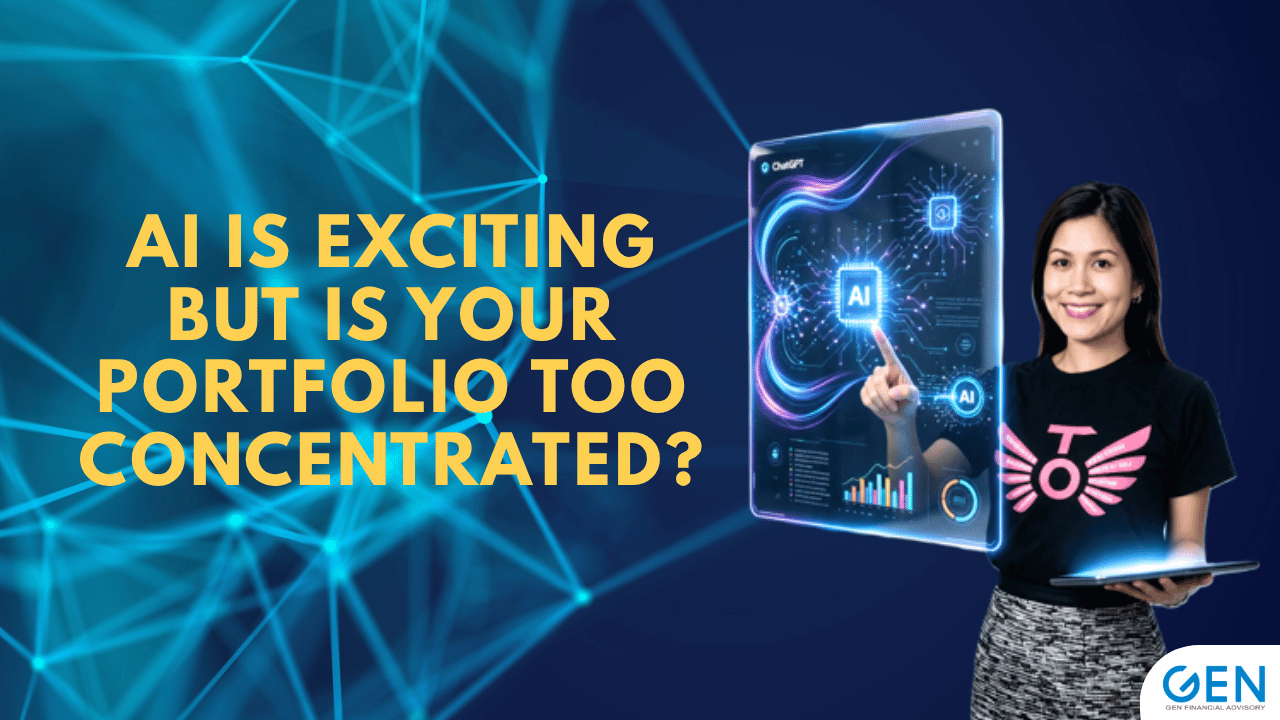
I recently read a noteworthy insight from Apollo Global Management titled “How Diversified Is Your Portfolio, Really?”.
Today, so much of the investment discussion is centred around artificial intelligence. Many investors understandably want to participate in this growth opportunity. But Apollo raised an interesting point. An investment portfolio may look diversified across different sectors and asset classes yet still be exposed to the same underlying factor AI. Apollo noted that AI is increasingly linking areas of the market that historically behaved differently, making true diversification even more important.
That made me think about something I have been seeing too. Some new clients who invested through DIY platforms have shown me their investment portfolios. On the surface, they owned many different funds and ETFs. But when we looked underneath, quite a number were still heavily exposed to the same US technology and AI-related companies.
So perhaps this is a good time to ask:
Is your portfolio truly diversified or has AI quietly become a much bigger part of it than you realise?
AI Is Still an Opportunity
AI may continue to transform businesses, improve productivity and create exciting investment opportunities for many years. The issue is not whether AI is good or bad.
The more important question is:
How much of your portfolio is already depending on the same AI story?
When an investment theme performs strongly, it is natural for us to want to participate in it. Technology is doing well so we buy more technology-related funds. AI is doing well so we add an AI-related fund. US equities are doing well so we add another US fund or ETF.
Each decision may make sense on its own. But when we put everything together, we may discover that a large part of the portfolio is actually relying on the same companies and the same investment theme. That is where concentration risk can start to build up.
A Common Mistake: Funds, Not Portfolio
One common misconception is that owning many funds automatically means your portfolio is diversified. For example, you may own:
- a US equity fund
- a technology fund
- a global equity fund
- an S&P 500 ETF
- an AI-related fund
They all sound different. But when you look underneath, some of these investments may hold many of the same large technology companies. Owning different funds does not necessarily mean you are taking different risks.
This is something I often see with new clients who have been investing independently through DIY platforms. Over time, they may have added one fund after another. One fund may have been bought after reading an article. Another because it had been performing well. And another because AI had become the latest investment theme.
Eventually, they may own many investments with different fund or ETF names but there may not be an overall portfolio strategy behind them. The question is therefore not just: “How many funds do I own?” It is also: “What am I really exposed to and am I investing in many of the same companies?” This is why when I review a portfolio, I prefer to look at the overall asset allocation rather than simply asking whether each individual fund is doing well.
Diversification Is More Than Owning Many Funds
Diversification is more than simply owning many investments. What matters is understanding whether your investments are exposed to the same risks, or whether they can behave differently under different market conditions. This becomes especially important as you approach retirement. Retirement can last 20 to 30 years or even longer.
Over such a long period, your portfolio will have to go through different market cycles, changes in interest rates, inflation, economic growth and unexpected world events. That is why I believe we should not build a retirement portfolio around one single investment idea no matter how exciting that idea may be.
AI may be today’s big opportunity. A few years from now, the market may be talking about something completely different. The investment goal should be to build a portfolio that can continue working through different market conditions.
Keep an Eye on the Downside Too
When markets are rising, it is easy to focus mainly on potential returns. But as we move closer to retirement, managing downside risk becomes increasingly important. The mathematics of losses can be unforgiving. If an investment falls by 50%, it needs to rise by 100% just to get back to where it started. If it falls by 75%, it needs a 300% gain to recover. This is why risk control matters. The financial goal is not simply to chase the highest possible return. It is to avoid taking unnecessary risks that could cause lasting damage to a long term financial plan.
For pre-retirees, this becomes even more important. At this stage of life, investing is no longer simply about accumulating as much as possible. You also need to think about protecting what you have built, creating future income and making sure your money can continue supporting you throughout retirement.
What Can You Consider in Your Portfolio?
Rather than focusing on individual funds, you can look at how the different parts of an investment portfolio work together. Some areas worth considering include:
Growth
Where will your long-term growth come from? Are you relying too heavily on one market, sector or investment theme?
Income
As retirement approaches, does part of your portfolio have the potential to provide income and greater stability?
Diversification
Are your investments genuinely spread across different markets, sectors and asset classes or are several holdings ultimately exposed to the same underlying risks?
Defensive Assets
Do you have investments that may behave differently during periods of market uncertainty?
The purpose is not to tell you what to buy. It is to help you take a step back and understand whether the different parts of your portfolio are working together.
Take Charge of Your Investment Portfolio
Apollo’s insight was a useful reminder that a portfolio can look diversified on the surface while still sharing the same underlying risk. So the purpose of reviewing your portfolio is not to predict whether AI will succeed or fail.
It is simply to make sure that one exciting investment theme has not quietly become too large a part of your financial future. Good investing is not about avoiding opportunities. It is about making sure no single opportunity becomes the whole investment plan.
As retirement gets closer, it is worth making sure your investment portfolio is still working towards the retirement lifestyle you want.
Article by Lee Meng
Email: meng.lee@gen.com.sg
The writer is an Executive Financial Services Consultant of GEN Financial Advisory