Integrated Shield Plan (IP) – What Should I Do If My Premiums Keep Going Up?
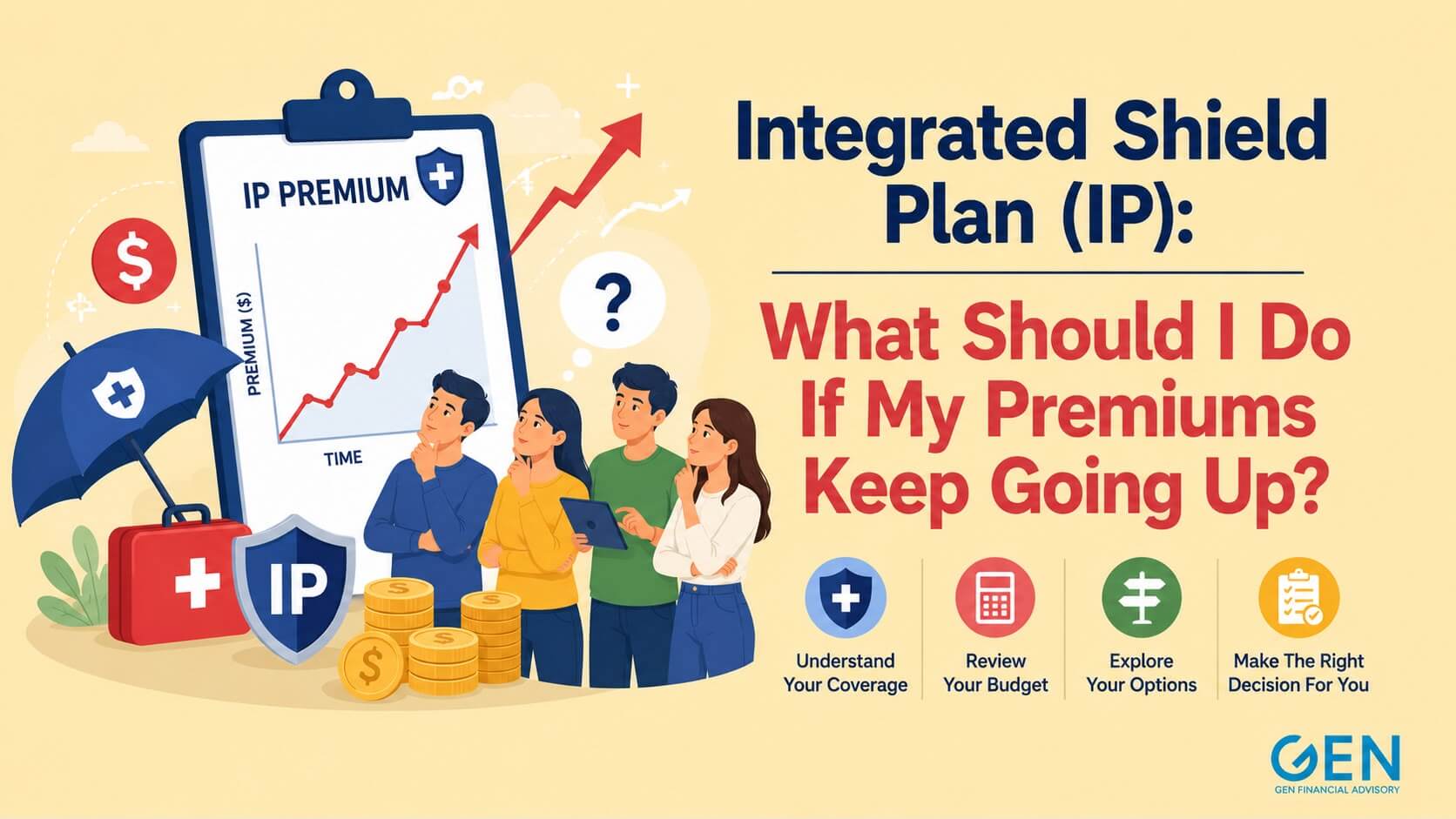
“When will the IP premiums come down or at least, stabilise and stop increasing?”

It is a common question, a fair one and a hopeful one.

Unfortunately, I think we may now be asking the wrong question.

Healthcare costs are rising much faster than general inflation. The latest WTW Global Medical Trends Survey projects insured medical costs in Singapore to increase by 16.9% in 2026, after increasing 15.5% in 2025. Whether the eventual number is slightly higher or lower is almost beside the point. The long-term direction is clear — healthcare costs are likely to continue rising for many years to come.

If medical insurance premiums is to fund medical insurance coverage which in turns pays for medical costs in Singapore, the logical and reasonable conclusion will be that unless medical costs reverse and starts trending sideways or downwards, IP premiums will have to increase in tandem.

If the expectation of permanent increasing IP premiums becomes a reality, how should we rethink the whole IP premiums and medical coverage issue that affects all of us, our family and our finances?

Medical Insurance 101

When it comes to financial planning, the objective of medical insurance is to remove the uncertainty of medical costs and the purpose is to provide peace of mind. We do not buy medical insurance because the premiums are cheap or affordable. We buy medical insurance because it can do something we can’t or don’t want to do by ourselves – set aside a large sum of money waiting for a medical liquidity event that may or may not happen.

If this premise is true, then the goal of medical insurance like our IP should be judged on the uncertainty it removes, the peace of mind it provides and the financial protection we receive.

Yet, we naturally tend to evaluate our IPs based on today’s premium. Some may conclude that private hospitals are unnecessary. Others feel MediShield Life should be sufficient. Many simply focus on whether premiums have become “too expensive”.

These are understandable reactions, but I do not think they are the right starting point. At least not now and not moving forward.

The objective of healthcare planning should not be to keep premiums low. The objective should be to ensure that our healthcare protection and by extension, our peace of mind remains sustainable throughout retirement.

And, those are two very different things.

In my opinion, to plan with the goal of removing financial uncertainty and achieving a peace of mind for the long term, we have to acknowledge the new risks and understand how to plan for them.
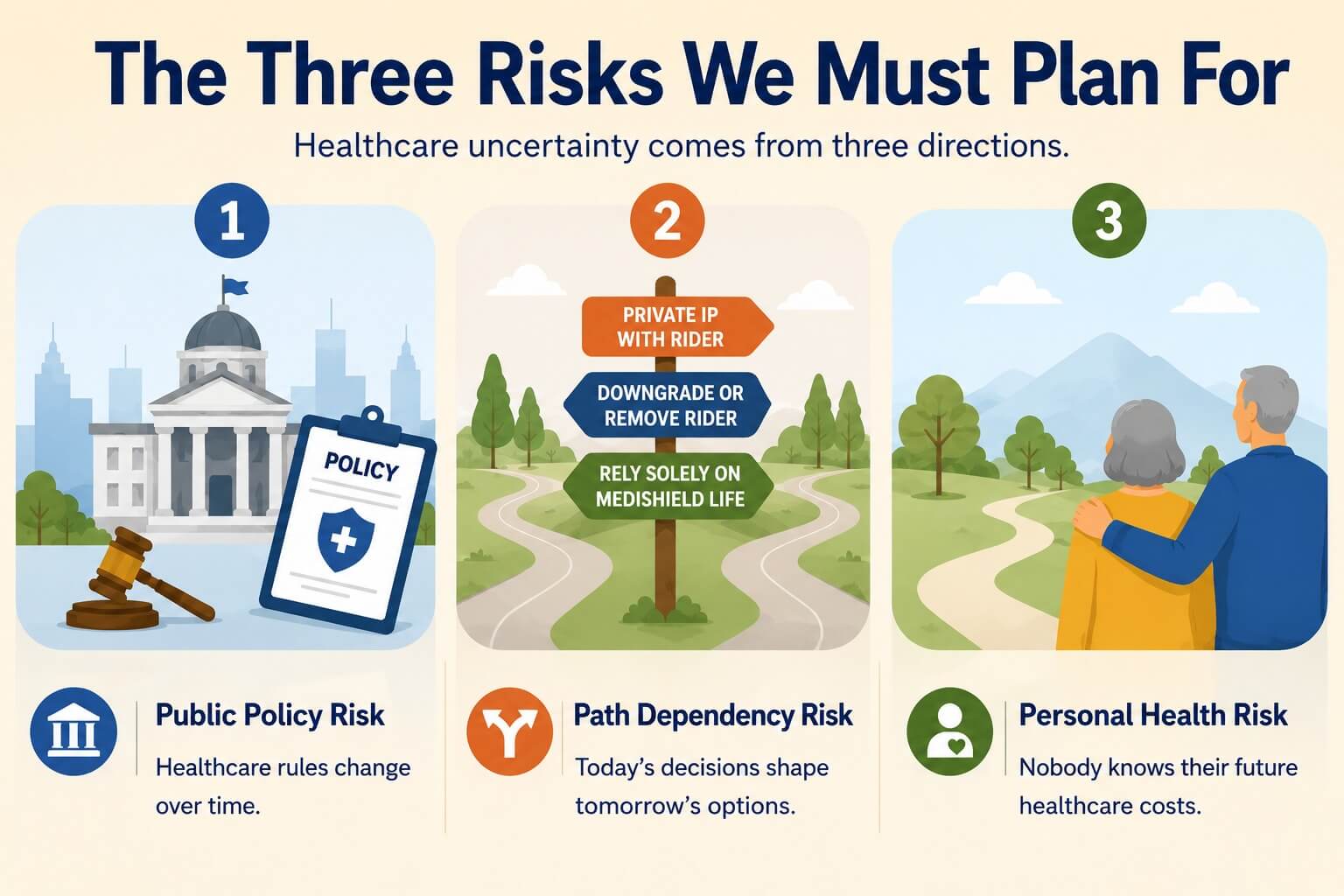
IP Planning Today Is Really Planning Against Three Risks

Financial planning framework by Lee Meng Choe. AI-generated illustration.

When I first started advising clients more than twenty years ago, choosing an IP was largely about deciding which hospital they wanted to be treated in.

Today, I think IP planning has become much more complicated because, from a financial planning perspective, we are really planning against three different risks.

1. Public Policy Risk

Healthcare financing rules do not remain the same forever.

Over the years, we have seen changes to rider structures, deductible rules, co-payment requirements and the Cancer Drug List. These changes affect what is covered, how much policyholders pay themselves and ultimately the value of our healthcare protection.

The reasons behind the changes are sound but they do bring about real and impactful changes nonetheless.

With every change that created more “holes” in the IP umbrella, our potential out-of-pocket obligations increase and our financial uncertainty goes up. We can be a “good soldier” and follow through with the premium payment responsibilities but through no fault of any, the landscape has shifted. While we continue paying premiums, the protection available to us may gradually change over time.

Healthcare planning today is therefore no longer just planning against illness. It is also planning against future policy changes.

2. Path Dependency Risk

This is perhaps the most overlooked risk.

While not always irrevocable, IP decisions are often difficult to reverse. This means that once you have decided to be covered with an insurer, or to drop your IP rider or perhaps, to rely solely on MediShield Life, that is the path that you have chosen and you will have to face all future medical bills with the path that you have chosen.

The problem is that we don’t have a chance to rehearse or try out which path suits us best and we certainly have no idea what type of medical issues we will have (if any) in the future. In my experience of recommending and making claims on IPs for more than 20 years, I’ve seen my fair share of “buyer’s remorse” and it’s not the type where a client felt they bought the wrong plan, it’s the type where they regret not buying enough.

Every medical bill is the same when we are paying with our own funds – it costs $1 of our own money to pay a bill of $1. And, every medical bill is the same when we are paying with insurance – it costs “cents on the dollar”. The regret is using 100 cents dollar when we could have used 3 or 4 cents dollar.

Think, if I were to suggest that the person you should marry is the first person you know when you start work and you will have no opportunity to date or engage first. What are the chances of the marriage working out?

Not nil but certainly poor.

The path dependency risk is like you having to make an early decision to get married without dating or engagement and if you decide to, for whatever reason to divorce, you will not be able to get married again.

It does not sound right but this reality is a risk that many face, especially in making the difficult decision to downgrade or terminate their IPs.

3. Personal Health Risk

In investing, there is a concept known as price discovery.

Nobody knows today what a company is truly worth. Over time, the market gradually discovers its value. Some buy, others sell and eventually, a price emerges and that is the real value of the company.

Healthcare or rather, our lifetime health costs are similar.

None of us knows whether we will remain healthy throughout retirement or develop cancer, heart disease or another serious illness. We are all going through our own personal health price discovery.

The logic is simple – if our lifetime healthcare costs are zero, we don’t need medical insurance. If our lifetime healthcare costs are high, we need good insurance.

There is only one problem – we don’t know or rather, it is not knowable.

This is perhaps the ultimate risk multiplier because our health ultimately amplifies the consequences of every decision we make about healthcare protection.

So, What Can We Do?

Financial planning framework by Lee Meng Choe. AI-generated illustration.

If IP premiums are going to continue to go up, if the risks that are affecting IPs have changed and if IPs are here to provide a peace of mind, then we have to ask new questions and approach the planning differently.

Rather than asking whether we should keep or cancel our IP, I would suggest taking a financial planning approach using these three simple financial planning principles of portfolio approach, budgeting and regular reviews.

1. Portfolio Approach – Using Private Plans to Mitigate Public Policy Risks

An IP should never be considered on its own. It can stand on its own if the coverage is all-encompassing but it has never been a “cover it all solution”.

A comprehensive protection portfolio should also include insurance that covers personal accident, critical illness, disability, long-term care and perhaps even cancer-specific coverage. These privately owned policies that are not subject to changes in rules or regulations and the terms and conditions remain the same from the time of purchase.

If your portfolio is comprehensive, the pain from IP changes while still hurt, is mitigated and if you have very good coverage from other plans, that may set the stage to actually downgrade your IP with confidence.

2. Use Budget As A Guide

Every financial goal requires a budget. Healthcare should be no different.

The mistake many people make is to start with the premium and then ask whether they can afford it. In financial planning, we usually do the opposite. We first decide what we can sustainably afford, then choose the solution that fits within that budget.

Buying an IP should be no different.

Rather than asking, “How much does this IP cost?”, perhaps we should ask, “How much of my income should I allocate towards healthcare protection?”

As a starting point, I generally suggest budgeting around:

  • 4% of income for those who wish to maintain private healthcare access with a private IP and rider.
  • 2% of income for those who are comfortable with a public IP and rider.

For retirees, I generally suggest tripling these percentages. Retirement income is usually much lower than employment income, while healthcare risks continue to increase. As a result, healthcare naturally takes up a larger share of retirement cashflow.

If your current IP premiums remain within your budget, maintaining your existing coverage may still be the right decision. If premiums begin exceeding your budget, that is the point to review your options and consider meaningful adjustments.

The problem is not necessarily that IP premiums have become too expensive. The problem may simply be that healthcare was never properly budgeted for in the first place.

3. Review and Adapt

We have to change because everything around us changes. This is certainly true for health, healthcare and healthcare financing. What we can control are the changes we make and we hope to make changes that are sensible, practical and maintain our peace of mind.

To begin with, make an effort to stay updated or if not, get a trusted advisor to guide you through the changes – not just for a one-time decision to buy or downgrade an IP, but throughout a lifetime of healthcare planning.

Next, commit to take a planning approach in all decisions. If the right decision is to set aside more than 4% of your income for IP and that is perfectly okay but it must not be at the expense of other needs that can play just an important or even more important role. Taking a planning approach where every decision is considered as part of an overall plan is the way to keep planning the main thing.

Sometimes, Not Downgrading May Be The Right Thing To Do

According to the Ministry of Health, Singapore’s public hospitals provide about 80% of the nation’s hospital beds, yet they are currently treating around 90% of all hospital patients. One reason is that many policyholders eventually downgrade or give up private hospital coverage because premiums become increasingly difficult to maintain.

This is precisely why recent policy changes have focused on slowing the growth of healthcare costs and IP premiums—not because premiums can be frozen, but because they need to remain sustainable.

In a way, healthcare is much like our transport system. The system does not work if everyone takes public transport (even if it’s the most cost effective and environmentally friendly option) nor can the system work if everyone owns their own car (even if affordability is not an issue). If everyone insists on driving, roads become congested. If everyone relies solely on public transport, trains and buses become overcrowded.

For those who can comfortably afford private healthcare, remaining in the private system does not simply benefit themselves. It also helps reduce demand on an already heavily utilised public healthcare system.

This is why I would encourage retirees not to over-downgrade simply because premiums have become uncomfortable. The objective is not to pay the lowest premium possible. The objective is to minimise your out-of-pocket costs on a premium commitment that you can afford.

New Questions. Same Objective.

Climate change has changed the questions we ask.

We no longer ask when temperatures will go back to normal. We ask how to live in a warmer world.

Perhaps it is time we do the same for healthcare planning. Instead of asking when IP premiums will stabilise, we should ask how to maintain the maximum healthcare protection we can sustainably afford throughout retirement.

Because the objective has never been low premiums.

The objective has always been peace of mind.

Article by Lee Meng Choe
Email: mengchoe.lee@gen.com.sg

The writer is the Executive Director (Advisory) of GEN Financial Advisory

NEED ANY HELP ?

If you want to know more about Financial Planning or any other enquiries, you may contact me through whatsapp, schedule an appointment with me or fill up the form below and I will get back to you as soon as possible.

GEN FINANCIAL ADVISORY

Lee Meng Choe
Executive Director (Advisory)

RNF No. LMC200165729
BsSc (Hons) Account & Finance, FChFP

SCHEDULE APPOINTMENT WITH ME:

30 Mins Complimentary Discussion Booking

FIND OUT MORE ABOUT ME:

Lee Meng Choe Profile

CONNECT WITH ME:

SEND ME A MESSAGE:

    Your Name *

    Your Email *

    Your Contact *

    Your Message *

    By providing your personal data in the field(s) above, you hereby consent to the collection and use of personal data to contact you, by way of telephone calls, SMS/MMS and emails for the purpose of attending to your enquiries. Please ensure that you are the user and/or subscriber of the telephone number(s) and/ or email address(es) provided. We dislike spam as much as you and will never rent or sell your information. By providing your personal data in the above field, you agree to the terms of use.

    2026-07-03T14:50:43+08:00
    Go to Top