Premium Financing for Insurance Plans: Is It Worth the Risk?
With interest rates starting to come down from the highs of recent years, I have noticed renewed interest in premium financing for insurance policies.
The concept is relatively straightforward. Instead of using entirely your own money to pay for a large insurance premium, you borrow part of the premium from a bank. If the return or distributions from the insurance policy are higher than the interest you pay on the loan, you potentially earn a positive spread.
It can look particularly attractive when interest rates are low.
But there is an important distinction to make: premium financing is not simply buying an insurance policy. It is buying an insurance policy using leverage.
And leverage changes the risk considerably.
Why Premium Financing Can Be Attractive
There are several reasons why investors, particularly high-net-worth individuals and retirees, may consider premium financing.
1. You can potentially earn a positive spread
The basic attraction is the difference between the financing cost and the return from the policy.
As a simplified example, suppose the effective return or distribution from an insurance policy is 3.7% a year while the borrowing cost is 2.0%.
There is potentially a 1.7% spread between the two.
And because the client has only put up part of the premium using his or her own capital, the return on the client’s actual capital can be enhanced through leverage.
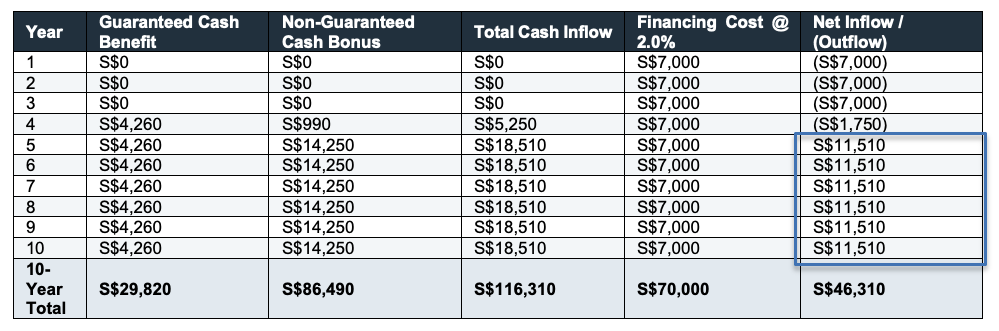
When financing rates are low, the mathematics can look very attractive. Using a policy often used in premium financing, someone is able to earn of spread of $11,510 per year (Table 1) from Year 5 onwards.
Table 1: 10-Year Cash Flow Illustration
Based on a S$500,000 policy, 70% bank financing and a 2.0% p.a. financing cost. Policy cash benefits are based on the 4.25% investment return illustration.
Click on the above image to enlarge
Note: The non-guaranteed cash bonus is not guaranteed. The financing cost is assumed to remain at 2.0% throughout the 10 years; actual borrowing costs may change.
2. Insurance policies are generally less volatile than equities
Another attraction is that the underlying asset is an insurance policy rather than an equity portfolio. A participating insurance policy, for example, does not fluctuate in value every day like shares do.
For someone approaching or already in retirement, this can be psychologically appealing. There is no need to watch markets moving up and down every day, and the expected cash flows can appear considerably more predictable.
However, lower volatility should not be confused with lower overall risk.
The policy itself may be relatively stable, but once borrowing is introduced, the financing arrangement introduces an entirely different set of risks.
3. It can provide a relatively passive stream of income
Certain insurance policies are structured to provide regular distributions.
After the initial arrangement has been put in place, there may be relatively little for the policyholder to manage compared with running an investment portfolio.
For someone who does not want to constantly monitor financial markets, rebalance investments or decide which assets to sell to fund retirement spending, this simplicity can be attractive.
4. A large policy can potentially fund a meaningful portion of retirement expenses
Premium financing also allows an individual to purchase a policy substantially larger than would otherwise be possible using only his or her own cash.
If the policy subsequently provides regular distributions, those payments could potentially contribute significantly towards retirement expenditure.
That sounds attractive. But this is also precisely where caution is required.
The larger policy has been made possible by borrowing. So alongside the larger potential income comes a larger financial obligation.
The Risks Are Easy to Underestimate
Premium financing tends to look best when interest rates are low and policy illustrations perform as expected.
Unfortunately, neither is guaranteed.
1. Your retirement plan becomes dependent on interest rates
This is probably the biggest concern I have with using premium financing as part of a retirement strategy.
Interest rates are a variable that the retiree cannot control.
When financing rates are low, the arrangement can work very well. But when borrowing costs rise substantially, the positive spread can quickly disappear.
We saw precisely this during the sharp rise in interest rates in 2022 and 2023.
Clients who entered premium financing arrangements when money was cheap suddenly found themselves paying substantially higher financing costs. In some cases, most or all of the expected spread disappeared.
That is particularly important for retirees.
If I am constructing a retirement income plan, I generally want to reduce uncertainty where possible. Premium financing does the opposite in one respect: it introduces future borrowing costs into the retirement equation.
You are effectively making at least a partial bet that financing costs will remain manageable.
2. The illustrated bonuses and distributions may not materialise
The second variable is the performance of the insurance policy itself.
For participating policies, part of the projected returns may depend on future bonuses declared by the insurer.
These projections are not the same as guarantees.
If investment returns, claims experience or other factors affecting the participating fund are weaker than expected, insurers may reduce future bonuses.
The problem becomes more significant when the policy is financed.
Without leverage, lower-than-expected bonuses simply mean that the policyholder receives a lower return.
With premium financing, the interest on the bank loan still has to be paid.
So the margin between what the policy earns and what the financing costs can become much smaller — or potentially negative.
3. Early surrender can be particularly painful
Insurance policies are generally designed to be held for the long term.
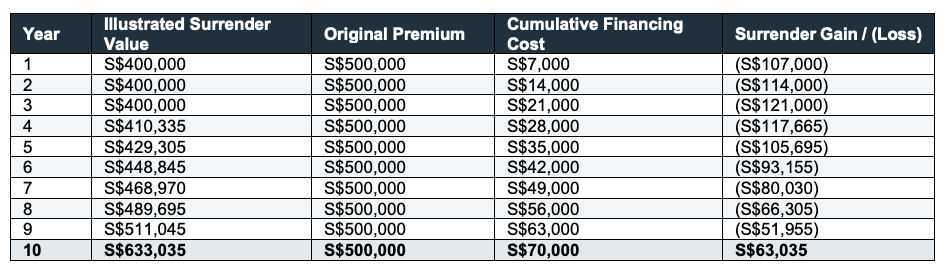
Surrendering during the early years can result in a surrender value substantially below the original premium. In Table 2 below, early surrender, in the first 9 years, will result in substantial early surrender losses.
Table 2: Illustrated Surrender Value and Gain/Loss
Based on the 4.25% investment return illustration for a S$500,000 policy, with cumulative financing cost calculated at 2.0% p.a. on S$350,000 of bank financing.
Click on the above image to enlarge
Note: This table focuses on the policy surrender value and financing cost only. It does not add back cash benefits or bonuses received during the period.
With premium financing, this problem can be magnified because the policy purchased is typically much larger than the amount of capital the client actually contributed.
Table 2 uses a $500,000 policy as an illustration; in reality, some policies can be even larger, leveraging a bigger loan quantum, and surrender losses will be even bigger. If circumstances subsequently force you to surrender the policy when surrender values are still low, the bank loan still needs to be repaid.
Leverage amplifies gains when things go well.
It can also amplify losses when they do not.
4. The financing arrangement itself can change
There is another risk which is sometimes overlooked.
The insurance policy may be long term, but the financing arrangements offered by banks are not necessarily fixed for the entire life of the policy.
Interest margins can change. Lending criteria can change. Collateral requirements can change.
Depending on the financing structure, the client could potentially be asked to provide additional collateral or repay part of the loan.
That creates a liquidity risk.
This is particularly relevant for somebody in retirement who may no longer have employment income and may have much of his or her wealth committed elsewhere.
5. You will be out-of-pocket during the first few years
Insurance plans that lend themselves to premium financing arrangements are whole-life plans, that usually pay out after an accumulation of a few years. In Table 1, I have used a real whole-life plan for such an arrangement, and the plan only pays out after 3 years, with the payout in Year 4 being too low to offset financing costs. Hence, you will be out-of-pocket in the first 4 years with this plan.
So, Is Premium Financing a Bad Idea?
Not necessarily.
For the right person, premium financing can be a legitimate wealth-planning tool.
Someone with substantial liquid assets, strong cash flow and the financial ability to repay the loan even under unfavourable circumstances may be comfortable accepting these risks.
But I would be considerably more cautious about using premium financing simply because the projected retirement income looks attractive.
Conclusion
As with practically all financial solutions, one man’s meat is another’s poison. Banks have become more active in promoting premium financing options to clients, often presenting them as a relatively low-risk way to use leverage, earn a spread and create an income stream.
There are, however, downsides which people need to consider before participating in such an arrangement. Premium financing for insurance policies can work for some, and not for others. The best premium financing arrangement is not necessarily the one with the highest projected return. It is the one that still works when conditions become less favourable.
A financial adviser will be able to help you understand if such an arrangement, despite its drawbacks, works for you. Have a conversation with me if you would like to understand more.
Premium financing can be attractive when borrowing costs are low and the policy performs as expected. As detailed in my article, it can provide you with an income to supplement your other sources, while enabling your capital outlay to be low, thereby tapping into the power of leverage. Payout from insurance plans tend to be more stable, and fluctuate much less than the frequent movements in financial markets, and as such are used as a strategy by some, especially in times of low interest rates and financing costs.
But the success of the strategy depends on more than simply comparing the policy payout with the current loan interest rate. There are risks involved whenever with such an arrangement. I have however, developed 3 ways to test if it works for you. Click here to download the Guide to Premium Financing for Insurance Plans – 3 Ways to Test If It Works For You.

Article by Leon Loh
Email: leon.loh@gen.com.sg
Written in Sept 2026.
The writer is a financial consultant representing GEN Financial Advisory Pte Ltd