A Bowl of Ramen, a Weak Yen: What Does It Mean for Your Foreign Investments?
Introduction
I recently returned from Japan, and like many Singaporeans, I noticed something immediately.
A bowl of ramen at Ichiran Ramen cost me about ¥1,250 — roughly S$10. It is still more expensive than a bowl of Bak Chor Mee in Singapore (save perhaps for the Michelin-starred versions), but the gap in prices has narrowed significantly over the years.
This is not because Japan has suddenly become cheap. Rather, it is because the Japanese yen has weakened significantly against the Singapore dollar.
At first glance, this may seem like a simple travel observation. In reality, it reflects a much larger shift in relative currency strength and purchasing power — something increasingly relevant in a world where many Singaporeans invest globally.
A Different Japan from the Past
What struck me even more was how different this felt from the Japan I remember growing up with.
Back in the 1980s, Japan was widely seen as one of the most expensive countries in the world. The yen was strong, and travelling there felt costly — especially when measured against the Singapore dollar. Another major difference is this: our incomes in Singapore today are significantly higher than they were in the 1980s.
Back then, even a moderately priced trip to Japan felt out of reach for many Singaporeans. Today, for a large segment of the population, it feels far more accessible.
So what has changed? The yen has weakened. The Singapore dollar has strengthened. And importantly, our collective earning power has increased.
Japan did not simply become cheaper. We became relatively stronger. And this shift in relative strength is exactly what currency movements represent in financial terms.
In the late 1990s and early 2000s, the Japanese yen was considerably stronger against the Singapore dollar than it is today. During that era, Japan was at the height of its economic influence. Japanese electronics, automobiles and property companies dominated global headlines, and the country was often seen as an unstoppable economic powerhouse.
Japan felt extremely expensive. Even ordinary meals, train rides and hotel stays could feel disproportionately costly when converted into Singapore dollars. A holiday there was often viewed as a premium experience rather than a mainstream travel destination.
According to XE.com, the exchange rate in May 2000 was approximately ¥63 to S$1. Today, it is around ¥124 to S$1, meaning the Singapore dollar now buys almost twice as many yen as it did 25 years ago.
Singapore’s economy and wage levels have also strengthened. As a result, Japan today feels much more accessible to middle-income Singaporeans than it once did.
When Currency Movements Become Investment Risk
When we benefit from favourable exchange rates as travellers, we are effectively enjoying the upside of currency movements.
However, if you hold Japanese equities, Japan-focused unit trusts, or any yen-denominated assets, then you are also exposed to the downside.
A weakening yen can reduce the value of your investments in Singapore dollar terms, even if the underlying assets perform well.
This is often overlooked. Investors tend to focus on market returns, but forget that those returns must eventually be translated back into the currency they actually spend.
Currency Risk Is Not Just a Technical Detail
Currency exposure is often treated as a technical detail. In reality, it can be a material driver of investment outcomes.
A strong equity market combined with a weak currency can still result in modest — or even disappointing — returns in Singapore dollar terms.
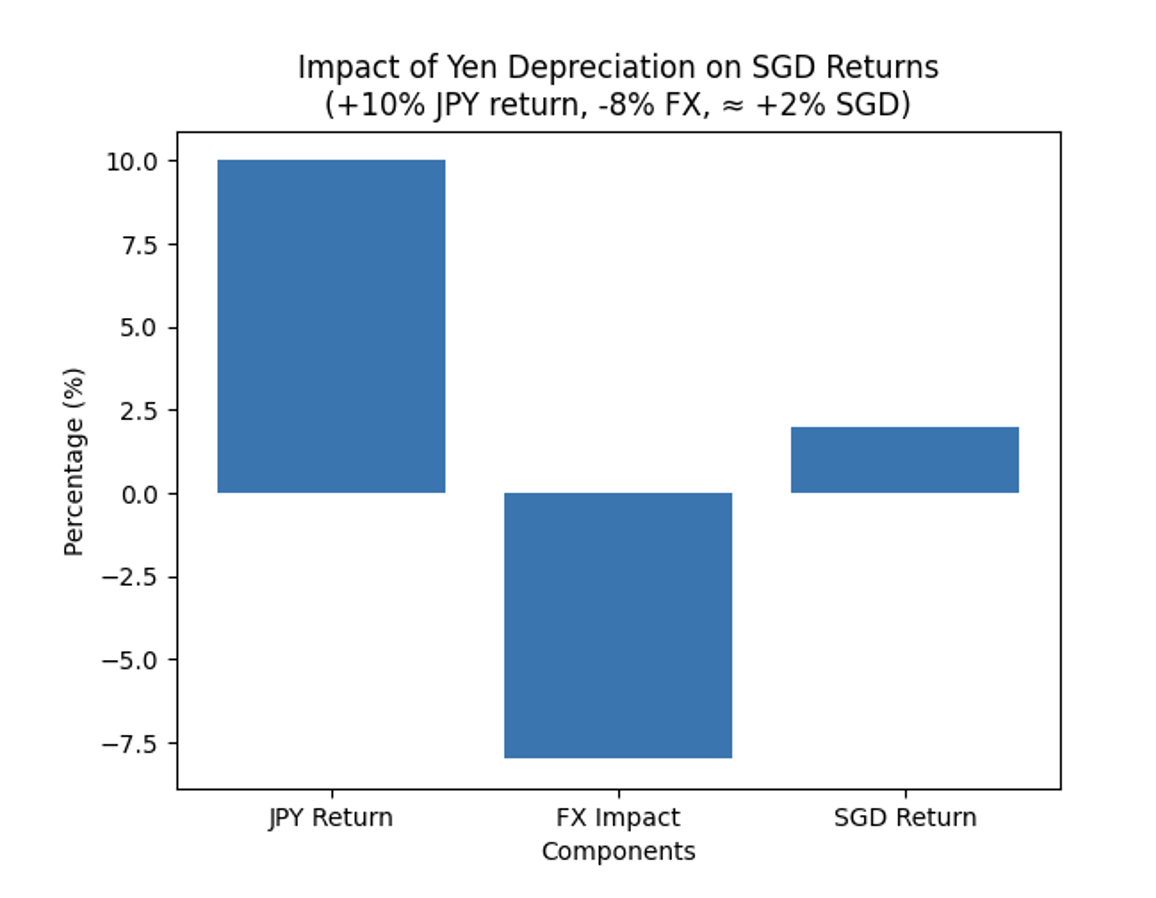
To illustrate this clearly, consider a simple example.
click above image to enlarge
Suppose you invest in a Japanese equity portfolio that rises 10% in yen terms over a year. At the same time, the yen weakens by 8% against the Singapore dollar.
When you convert your returns back into Singapore dollars, your gain is no longer 10%. Instead, it is closer to 2%.
In other words, the market performed well, but most of the gains were eroded by currency movements.
Over the last 10 years, the yen weakened significantly against the Singapore dollar, moving from around ¥79 to ¥124 per Singapore dollar (source: XE.com). This materially impacted investment returns for Singapore-based investors holding Japanese assets.
One such fund within our suite of investment solutions* returned 14.88% per annum over that 10-year period on an SGD-hedged basis, but only 8.52% per annum on an unhedged basis. That is a substantial difference.
*10-year returns for LionGlobal Japan Growth ending 19 May 2026.
To Hedge or Not to Hedge?
Currency hedging is the practice of reducing the risk that exchange rate movements will hurt the value of an investment. There is a cost associated with hedging, but in the example of the Japanese fund above, hedging helped investors enhance their gains in Singapore dollar terms.
This leads to the practical question: should you always hedge your currency exposure?
There is no one-size-fits-all answer.
Remaining unhedged allows investors to benefit from potential currency appreciation, but it also exposes them to greater volatility.
Hedging reduces that volatility, but comes with costs and removes potential upside.
The decision depends on your investment horizon, financial objectives and tolerance for fluctuations.
A Practical Way to Think About It
Instead of asking whether you should hedge everything, a more useful question is this: how much variability are you willing to accept?
Once you frame the problem this way, your decisions become clearer.
Currency exposure should not be accidental. It should be a deliberate choice aligned with your financial goals.
Many investors assume that diversification across countries automatically reduces risk. While geographical diversification is important, it also introduces currency exposure. An investor holding overseas equities may experience very different outcomes depending on how exchange rates move over time.
Conclusion
That ¥1,250 bowl of ramen was a small reminder of a much larger reality.
The story of a bowl of ramen becoming relatively affordable is ultimately a story about purchasing power. For consumers, a strong Singapore dollar can feel beneficial because overseas travel becomes cheaper. But for investors, the same currency movement can reduce returns from overseas assets.
In other words, currency movements create winners and losers simultaneously. Travellers enjoy stronger purchasing power abroad, while investors holding foreign assets may face reduced returns when converting gains back into their home currency.
Understanding this relationship is increasingly important in a world where many Singaporeans invest globally through unit trusts and ETFs.
There was a time when Japan felt expensive because its currency was strong and our incomes were lower. Today, it feels far more affordable because the yen has weakened while our earning power has increased.
As investors, we sit on the other side of this equation.
Currency movements affect not just what we pay when we travel, but also what our investments are worth in the currency we actually spend.
Ultimately, financial planning is not just about returns. It is about ensuring that your wealth translates into usable, reliable purchasing power in the real world.
I have worked to assess and manage currency risks throughout my career at both the corporate and personal levels. If you would like an advisor who understands currency risks and what they mean for your portfolio and financial well-being, I would be happy to have a discussion with you.
Article by Leon Loh
Email: leon.loh@gen.com.sg
Written in May 2026.