Your SRS Money Is Invested. But Is It Ready for Your Retirement?

Mdm Tan, civil servant, age 54.
She is looking forward to retiring at 60. She had invested a lump sum of her Supplementary Retirement Scheme (SRS) monies. However, there had been no follow up review of the investment and the ups and downs of the market were making her uneasy. I could understand her concern. With just six years to her preferred retirement age, she wanted greater clarity on how this money would support her retirement.
Through our SRS Planning Review Service, we looked at whether her existing investment was still suitable and how it could support her retirement plans.
When Retirement Gets Closer, the Questions Change
When retirement is many years away, we tend to focus on how much our investments can grow. As retirement approaches, the questions become more personal. When can I stop working? Where will my monthly income come from? What if the market falls just before I need the money?
For Mdm Tan, her concerns centred on three areas.
First, market risk. A fall in the value of her investment could leave her with less money for retirement.
Second, having money available when needed. Even if the investment could be sold, she might not feel comfortable selling it at a loss. But while waiting for a recovery, her living expenses would still need to be paid.
Third, timing risk. She might be ready to retire but would her investment be ready to support her plans?
For Mdm Tan, a market downturn close to retirement could affect her plans to stop working. Waiting for her investment to recover may mean drawing on other savings or working longer than she had hoped. This is why, when I work with clients approaching retirement, I look at when they will need the money and how their investments can support their retirement income needs.
Three Stages of SRS Planning: Start, Rebalance and Spend
When it comes to SRS planning, I use a simple three-stage process: Start, Rebalance and Spend. Whether we invest on our own or with professional help, our SRS money is ultimately set aside for retirement. As the withdrawal time draws nearer, we need to review how we manage it with greater attention to when and how it will provide the retirement income we need.
1. Start – Build Your Retirement Savings
In the earlier years, there is usually more time to invest for growth, considering your risk appetite and financial circumstances. With a longer investment horizon, there may also be more time to ride through market fluctuations although recovery is never guaranteed.
But making the investment is only the beginning. As our financial priorities change, we need to consider whether the way we invest should change too. For Mdm Tan, she had already taken the first step. She had contributed to her SRS account and invested the SRS money. Her concern now was how to prepare it for retirement.
This brought the next stage into focus.
2. Rebalance – Prepare Your Investment for Retirement
At 54, Mdm Tan was approaching the point where her retirement savings would eventually need to become retirement income. An investment that was suitable when retirement was far away may not be suitable for money that will soon be needed for spending. This does not mean selling everything simply because retirement is approaching. It means understanding which portion will be needed earlier and which portion can remain invested for longer.
I use the “drop and bounce” example to illustrate why recovering from an investment loss may take more than we realise.
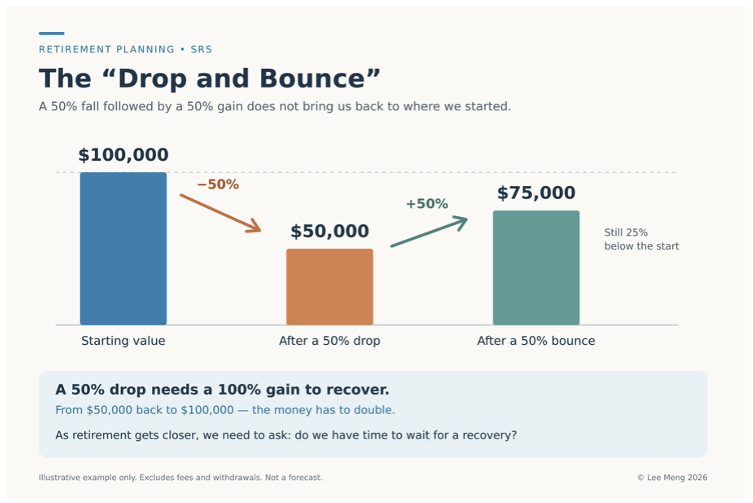
Suppose an investment of $100,000 falls by 50%. It is now worth $50,000. If it subsequently gains 50%, its value rises to $75,000, not back to $100,000. A 50% drop needs a 100% gain to recover. As retirement gets closer, we may have less time to wait for an investment to recover, especially if we need the money for our living expenses. When I review SRS investments with clients, I look at when they will need the money, how much risk they are comfortable taking and whether they want to continue managing their investments.
For Mdm Tan, the financial goal is to set aside enough for reliable retirement income while keeping some money invested for growth to help with rising costs. An SRS-approved annuity plan was considered for part of her retirement planning. We reviewed its benefits, guarantees and payout timing. Ultimately, the planning helped her feel more confident about where her income will come from when she retires.
3. Spend – Turn SRS Savings Into Retirement Income
For Mdm Tan, there is an important distinction between her preferred retirement age and her SRS withdrawal age. Retiring at 60 does not automatically mean she can begin penalty-free SRS retirement withdrawals at 60. The applicable age depends on the statutory retirement age prevailing when she made her first SRS contribution. This needs to be confirmed when planning her withdrawals. Any gap between stopping work and accessing SRS without an early-withdrawal penalty would need to be funded from other resources.
Under current rules, qualifying retirement withdrawals can generally be spread over 10 years, starting from the first penalty-free retirement withdrawal with only 50% of each withdrawal subject to tax. The timing and amounts should take into account other taxable income and retirement spending needs. Source: IRAS
When I work with clients, I look at how their SRS withdrawals can complement CPF LIFE, existing annuities and other investments. The goal is to provide income for basic expenses, allow for lifestyle needs and rising costs and ensure there is income beyond the SRS withdrawal period. For Mdm Tan, this means planning for her living expenses from age 60 including the years before her SRS withdrawals and other retirement payouts begin. By looking at these together, we can identify any income gaps and plan how her savings and investments can support her throughout retirement.

Article by Lee Meng
Email: meng.lee@gen.com.sg
The writer is an Executive Financial Services Consultant of GEN Financial Advisory